Waterloo Space Soldering Team (WSST) - University of Waterloo
Waterloo Space Soldering Team (WSST)
Our Team
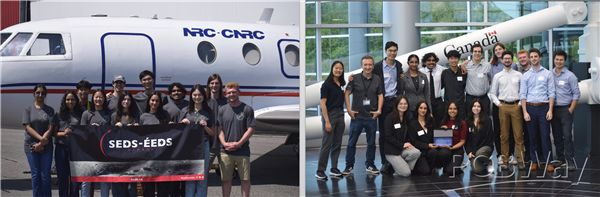
The Waterloo Space Soldering Team (WSST) is a University of Waterloo engineering student team, competing in the 9th annual Canadian Reduced Gravity Experiment Design Challenge (CAN-RGX), Canada’s microgravity research competition for students led by SEDS Canada, in collaboration with the National Research Council and the Canadian Space Agency.
Our team is a dynamic and ambitious group of 12 undergraduate engineering students at the University of Waterloo. All of these students are undergraduate engineering students in either mechanical, electrical, mechatronics, systems design, or biomedical engineering.
Project Objective
We know that over time, electrical components on spacecraft for deep space exploration missions degrade, requiring replacement. This replacement process is both costly and time-consuming since malfunctioning components must be transported from Earth. The ability to conduct soldering in microgravity environments would enable in-space electronics repairs, leading to significant cost and mass savings during launches.
Previous studies and projects have consistently shown that solder joints produced in microgravity exhibit increased internal porosity. Under Earth’s gravity, molten solder undergoes natural convection, and buoyant forces assist in removing trapped flux gas bubbles during the reflow process. In microgravity, these buoyant forces are absent, allowing gas bubbles to be trapped in the solidifying alloy. These voids compromise mechanical strength and diminish the electrical conductivity of the joint.
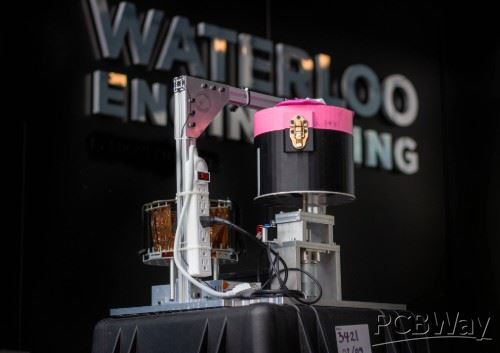
The overall goal of our project is to design a centrifuge (spinning cylindrical vessel) which simulates “artificial gravity”, to determine whether the quality of solder joints formed in microgravity can be improved if subject to centrifugal forces.
The Competition
Our project is part of the Canadian Reduced Gravity Experiment Design Challenge (CAN-RGX), Canada’s national microgravity research competition for students. The competition challenges university teams to design, build, and test innovative technologies in microgravity during parabolic flight campaigns. Our team won the Overall Excellence Award for CAN-RGX 7 in 2024. We were recognized for our strong experimental design, technical implementation, and research outcomes!

The System
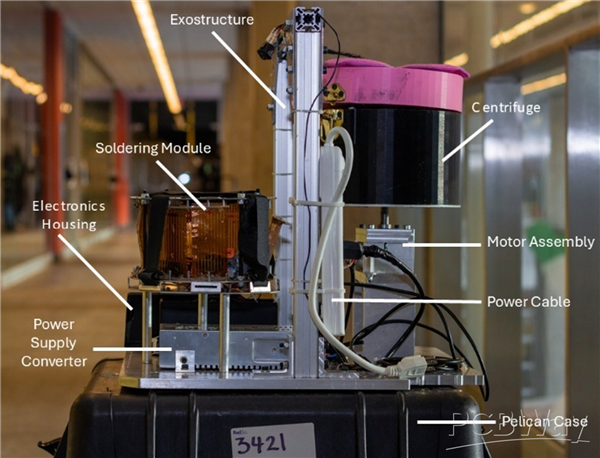
The centrifugal heating device is comprised of four primary subsystems:
- The centrifuge
- The soldering module
- The motor assembly
- The electronics and housing
Additional components include the exostructure, power supply converter and pelican case container.
Centrifuge Subsystem
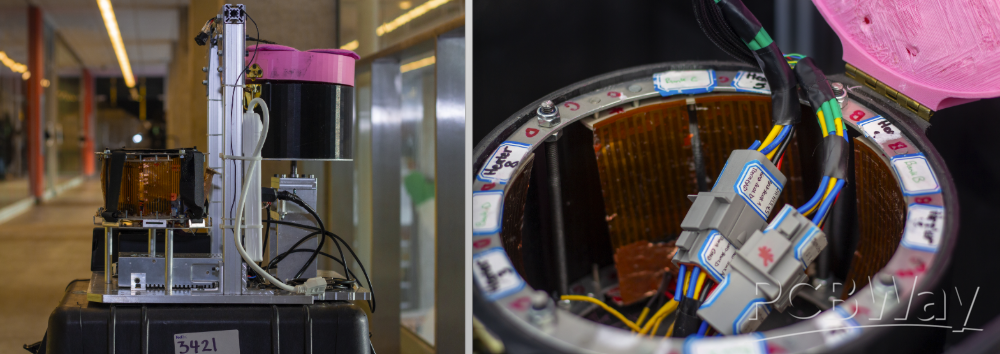
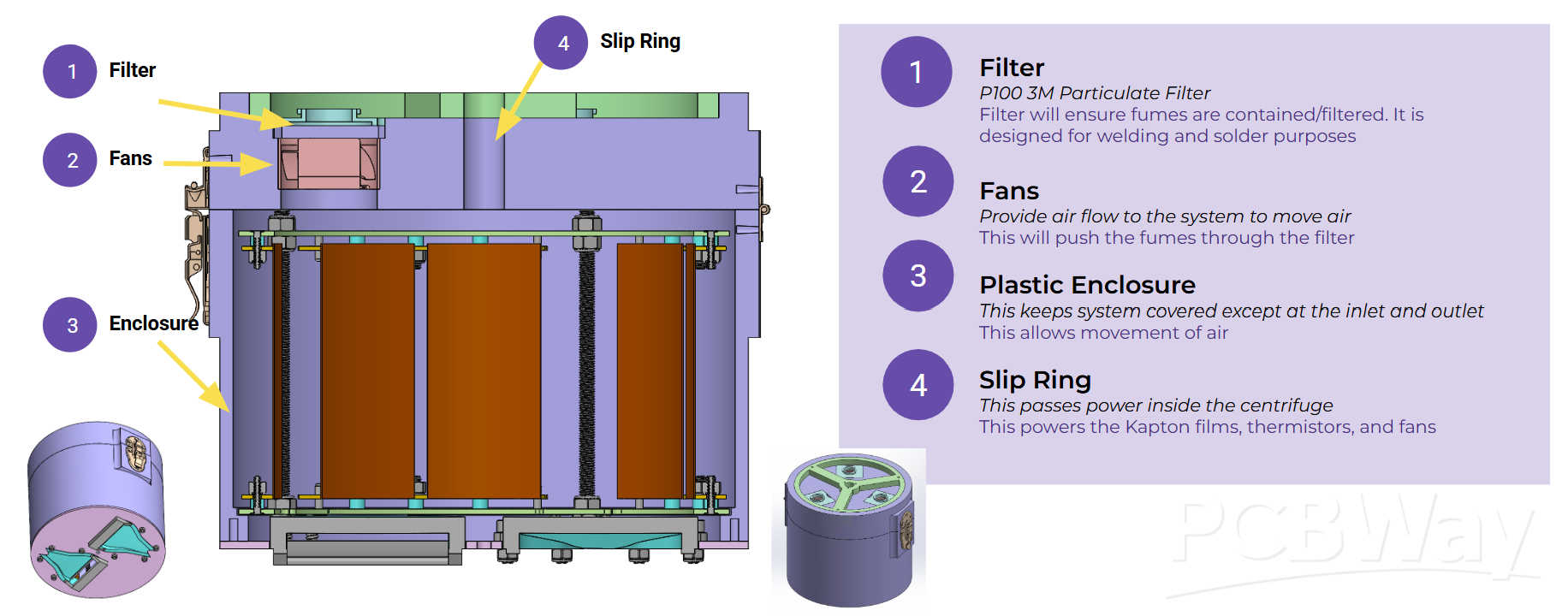
The centrifuge was a hollow cylindrical vessel, 3D-printed from ABS plastic. The centrifuge’s primary functions were to house the soldering module and prevent solder fumes from entering the surrounding pelican case. A hinge-and-latch mechanism allowed for easy access to the module while the spring preload provided resistance against vibration during centrifugation. Airflow and fumes management within the enclosure was accomplished using three fans and three 3M P100 particulate filters integrated into the lid.
Soldering Module Subsystem
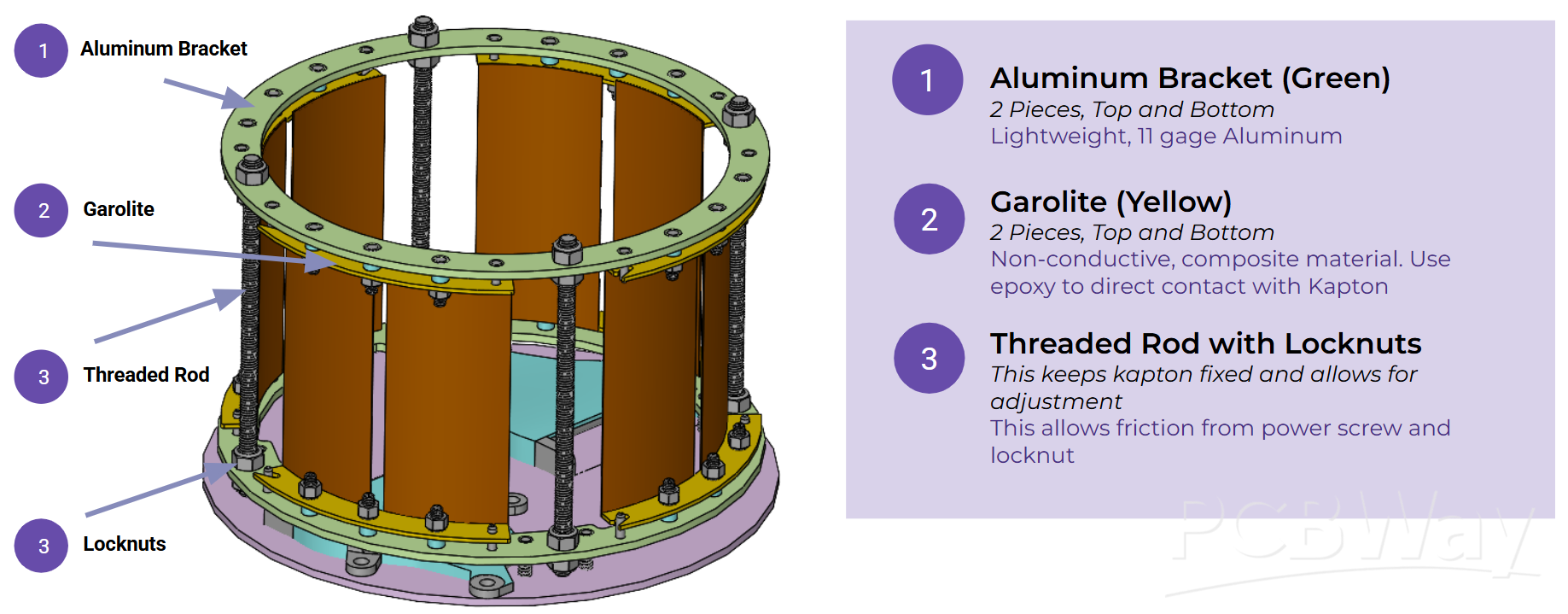
The solder module comprises the core components of the experimental setup, integrating both the heating system and the sample containment. The frame consisted of two water-jetted aluminium rings connected and secured by threaded rods. Eight evenly spaced Garolite brackets were attached around the circumference of the frame, each serving as a mounting platform for a Kapton polyimide heater film that were affixed to the brackets using epoxy. The brackets ensured uniform spacing of the heaters around the 6.5-inch diameter frame and provided thermal and electrical insulation at the contact points of the Kapton heaters, maximizing heat transfer to the solder samples. The assembly was supported by eight compression springs, designed to withstand forces equivalent to twelve times the assembly’s weight.
Motor Assembly Subsystem
The centrifuge rested on a central shaft that transmitted rotational motion from a gear motor to the centrifuge rotor assembly. A shaft coupler acted as a connector between the shaft and gear motor to securely and efficiently transfer power. Other critical elements included bearings to provide support and reduce friction during rotation.
Electrical Subsystem
Our experiment focuses on Component-Level Electronic-Assembly Repair (CLEAR), which investigates the feasibility of soldering electronic components onto printed circuit boards (PCBs) in space and microgravity environments. Because PCBs are central to our research, we are also designing custom boards specifically tailored to support the experiment.
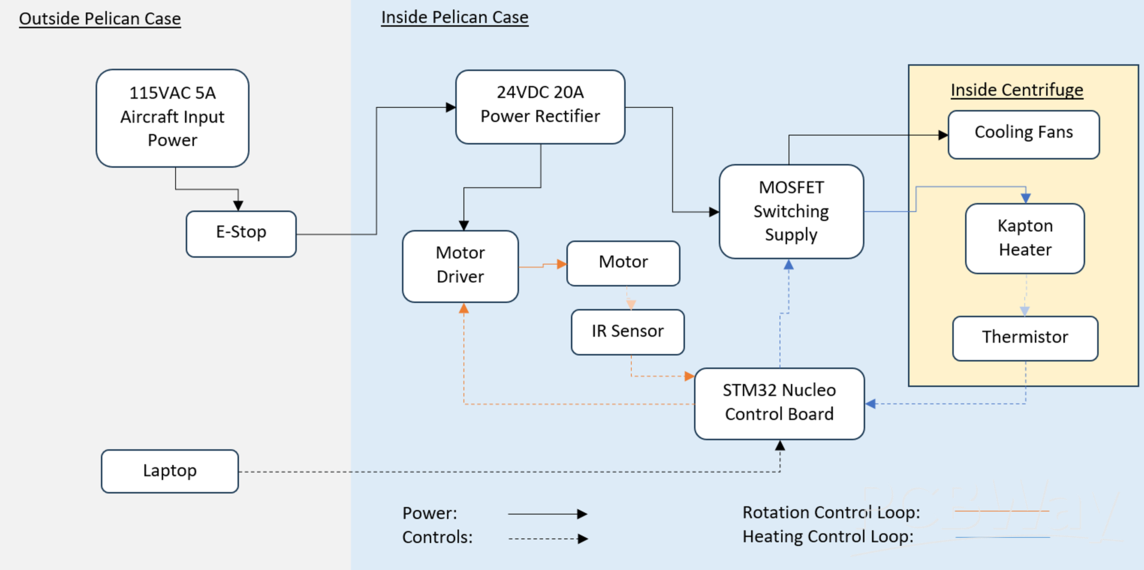
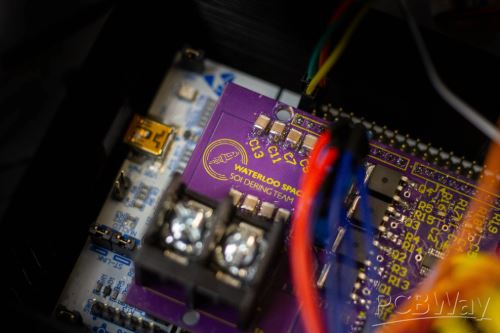
These custom PCBs will serve as the backbone of our system, allowing us to control the motor that drives the centrifuge, to minimize the need for extensive wiring and allow for the control of the eight Kapton heaters and thermistors. The PCB itself had four MOSFETS acting as low side switches between 24V and GND. These were controlled by signals from the STM32, and each MOSFET was connected to two heaters in parallel, each pulling approximately 1.2A. The PCB also contained a thermistor sensing circuit using a voltage divider. A known resistance of 5kΩ was used in combination with the varying resistance of the thermistor which changed inversely with temperature. By reading the thermistors resistance as the MOSFET was switched on and off, the temperature of the heater was controlled in a closed loop.
Below is an image of our PCB, which was ordered from Wpsload!
Other Electronics
Additional PCBs will be placed inside the centrifuge with electrical components, such as resistors, that will be soldered under varying simulated conditions. Following the experiment, these components and their solder joints will be collected as samples and analyzed using optical microscopy and micro-CT scanning. This post-analysis will be used
Team Contact
Website: https://uwspaceresearch.vercel.app/
Email: uwspacesoldering@gmail.com
Apply for sponsorship >>- Comments(0)
- Likes(0)